Federal labour board deems Air Canada flight attendants’ strike ‘unlawful’
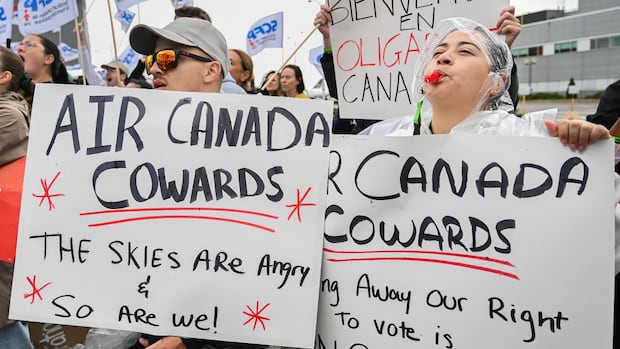
The federal labour relations board has deemed the strike by Air Canada’s some 10,000 flight attendants illegal and is ordering workers back to the skies.
In a decision released Monday morning, the Canada Industrial Relations Board (CIRB) said the defiance of a back-to-work order on Sunday by the Canadian Union of Public Employees (CUPE) is “unlawful.”
The order calls on the union to “cease all activities that declare or authorize an unlawful strike of its members and to direct the members of the bargaining unit to resume the performance of their duties” by noon ET.
The directive, written by CIRB vice-chairperson Jennifer Webster, also calls on the flight attendants themselves to resume their duties “immediately.”
The decision comes after a hearing on Sunday, following a frazzled weekend for travellers.
Flight attendants walked off the job early Saturday morning, leading to hundreds of flights being grounded. Less than 12 hours after the strike and lockout took effect, Ottawa intervened.
Federal Jobs Minister Patty Hajdu invoked a contentious section of the Canada Labour Code, asking the CIRB to send the two sides to binding arbitration and to order the airline and its flight attendants back to work in the meantime to “maintain or secure industrial peace.”
Air Canada says it hopes service returns ASAP
Air Canada announced early Sunday that it planned to resume flights, but just hours later, the union representing more than 10,000 flight attendants said in a statement that its members would remain on strike, defying the back-to-work order handed down by the CIRB.
CUPE has accused the Liberal government of “rewarding Air Canada’s refusal to negotiate fairly by giving them exactly what they wanted.”
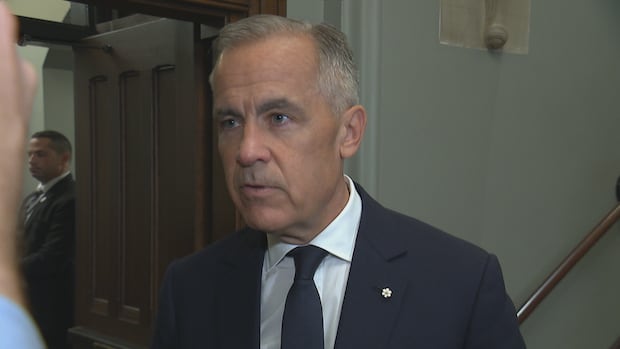
Prime Minister Mark Carney said flight attendants should be ‘compensated equitably’ and that it’s ‘disappointing’ that negotiations did not lead to an agreement as the Air Canada strike continues.
In a statement following the CIRB directive, Air Canada said it estimates 500,000 customers’ flights have been cancelled as a result.
“Air Canada regrets this impact on its customers and is fully committed to returning to service as soon as possible,” the airline said.
On Monday, Prime Minister Mark Carney said it’s important that flight attendants are “compensated equitably at all times” and called for quick resolution.
“It was the judgment of both the union and the company that they were at an impasse. That’s not my judgment, that’s their judgment,” Carney said. “So … we are in a situation where literally hundreds of thousands of Canadians and visitors to our countries are being disrupted by this action.”
He suggested Hajdu will have more to say later in the day.
Air Canada and CUPE have been negotiating a new contract for flight attendants after the previous 10-year contract expired in March.
Among the chief sticking points in negotiations are wages and “ground pay,” which covers the work that flight attendants do before a flight takes off and after deplaning.
According to CUPE, many duties performed by flight attendants prior to boarding and after deplaning, including performing required safety checks and assisting passengers, go unpaid under the current pay structure.
It says the airline proposed ground pay at 50 per cent of a flight attendant’s hourly rate. The union has been pushing for ground work to be paid at 100 per cent.
Air Canada has said publicly that its proposal includes an eight per cent increase in hourly wages in the first year, plus another four to eight per cent bump based on a new ground pay formula.
Under the proposal, the airline says, senior flight attendants would earn $87,000 annually on average by 2027.