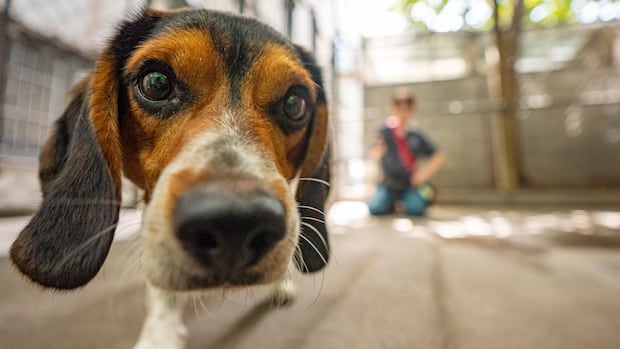
People often calculate the impact of climate choices – such as owning a dog – says Study
It appears that many people are not good at identifying which personal decisions contribute the most to climate change – and some of those who do do can come as a surprise.
A Study recently published Door de National Academy of Sciences heeft vastgesteld dat toen hem werd gevraagd om acties te rangschikken, zoals het ruilen van een auto die benzine gebruikt voor een elektrische, carpoolen of het verminderen van voedselverspilling, deelnemers uit een Amerikaans cohort niet erg nauwkeurig waren bij het beoordelen van hoeveel die acties hebben bijgedragen aan de klimaatverandering, die vooral wordt veroorzaakt door de afgifte van kasgassen die op zoek zijn naar broeikasgassen die zich occur when fuels are burned.
“People draw the impact on actual low-impact actions such as recycling, and underestimate the actual carbon effect of behavior much more carbon intensive, such as flies or eating,” said Madalina Vlapeanu, reports co-author and professor of environmental-social sciences at Stanford University in California.
The top three individual actions that help the climate, including avoiding aircraft flights, choose not to get a dog and use renewable electricity, were also the three that participants most underestimate. In the meantime, the lowest impact actions had changed into more efficient devices and changing light bulbs, recycling and the use of less energy when washing clothes. Those were three of the top four overestimated actions in the report.
Vlastanu said that marketing focuses more on recycling and the use of energy -efficient light bulbs than why flights or dog administration are relatively bad for the climate, so the participants were more likely to give those actions more weight.
How the human brain is wired, also plays a role.
“You can see that the bottle is being recycled. That is visible. While CO2 emissions, that is invisible to the human eye. So that is why we don’t associate emissions with flying,” said Jiayying Zhao, who teaches psychology and sustainability at the University of British Columbia.
Zhao added that it is easier to remember actions that we do that more often. “Recycling is an almost daily action, while flying is less frequent. It is discussed less,” she said. “As a result, people give a higher psychological weight to recycling.”
Of course there is also a lot of misleading information.
For example, some companies praise the recycling they do, while they do not tell the public about pollution that comes from their general activities.
“There has been a lot of intentional confusion to support the policy that is really outdated,” says Brenda Ekwurzel, a climate scientist at the non-profit Union of involved scientists.
Pets, flying and other contributors to climate change
Dogs are large meat eaters and meat makes an important contribution to climate change. That is because many of the farm animals that will become food will release methane, a greenhouse gas that contributes to climate change. Beef is especially impactful, partly because cattle are often raised all over the world on the country that was issued illegally. Since trees absorb carbon dioxide, the most common greenhouse gas, cutting them to increase cattle, is a double whammy.
“People just don’t associate pets with carbon emissions. That link is not clear in people’s heads,” said Zhao.
The owner of a carnivorous pet can lower their impact by looking for food made from sources other than beef. For example, Zhao tries to minimize the carbon footprint of her dog by feeding its less carbon -intensive protein sources, including seafood and turkey.
Aircraft emit a lot of carbon dioxide and nitrogen oxides, as well as contrails or vapor paths, tHat prevents heat from escaping into the room. A Round-trip Economy-Class flight on a 737 from New York to Los Angeles produces more than 1,300 pounds (590 kilograms) of emissions per passenger, according to the International Civil Aviation Organization, a United Nations Agency.

Skipping that single flight saves approximately as much carbon as living all kinds of meat per year, or living without a car for more than three months, According to EN estimates.
Learn from mistakes
Some of the largest climate decisions that individuals can make include how they heat and cool their houses and the types of transport they use. Switching to renewable energy minimizes the impact of both.
Recycling is effective in reducing waste on the way to dump, but the climate impact is relatively small because transposing, processing and re -use of recyclable is usually dependent on fossil fuels. Moreover, less than 10 percent of the plastics are actually recycled, according to the Environmental Protection Agency.
Other decisions with overestimated impact, including washing clothes in cold water and switching to more efficient light bulbs, are relatively less important. That is because those devices have a relatively small impact compared to things such as aircraft flights, so improving them, although useful, has a much more limited influence.
Experts say that the best way to combat a misunderstanding of climate effects is with more easily available information. The study supports that hypothesis. After participants finished ranking actions, the researchers corrected their mistakes and changed what actions they said they would take to help the planet.
“People learn from these interventions,” said Vlaatanu. “After learning, they are more willing to commit to actually more impactful actions.”